A Winter Evening, Planned Around What Is Already at Home
Plan a winter evening at home around useful light, a familiar activity and a comfortable seat, with a simple routine that needs no new purchases.
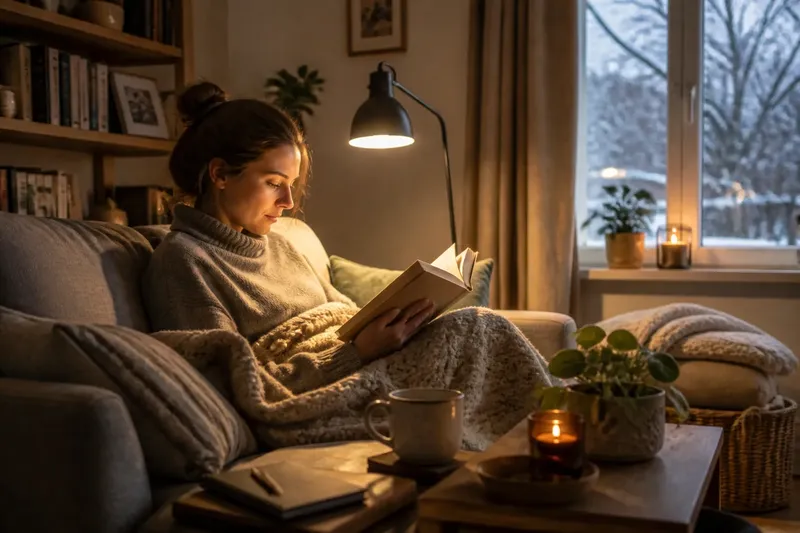
The most common mistake in planning a winter evening at home is treating comfort as something to buy before the evening can begin. That costs time and attention, and can leave you overlooking the useful light, familiar activity and comfortable seat already within reach.
Shape the light
Darkness can make a room feel unfinished if you expect it to resemble a bright daytime space. Relying on one overhead light may flatten the room and make a quiet activity feel exposed.
Switch on a table lamp or floor lamp near the place you plan to sit. If daylight remains, draw the curtains as it fades; for reading or making something, position the light where you need to see rather than illuminating every corner.
Say you have a sofa, a reading lamp and a book already in progress. Move the lamp so it falls on the page, settle on the sofa and leave the rest of the room dim. You have a clear reading spot without turning the evening into a lighting project.
Use the light that serves the activity, not the light that makes the room look staged.
Choose a familiar activity
Scrolling through options can consume the attention you hoped to recover. A vague plan for “a restful evening” encourages a search for the perfect film, recipe, craft or book instead of a simple start.
Pick something with a low starting threshold and a natural stopping point: read a few pages, knit a row, sort photographs into an album, listen to a familiar record or prepare a simple supper from ingredients already in the kitchen. The aim is to give your attention somewhere gentle to land, not to make the evening impressive.
If choosing still feels difficult, ask what would be pleasant for the next little while rather than what should fill the whole evening. Put the materials within reach, close unrelated tabs and begin with the smallest satisfying part.
Keep comfort simple
Preparation can quietly expand into rearranging furniture, hunting for a special blanket or deciding the room needs a new accessory. That often begins with an idealised picture of comfort that makes ordinary things seem inadequate.
Start with the place you already use. Straighten a cushion, bring over a clean blanket and set down a mug or glass on a stable surface. If the chair feels awkward, try the sofa or a dining chair with a cushion; comfort depends on how your body feels, not on whether the setting looks like a catalogue.
Check for small irritations before settling in: a draught, screen glare, a cluttered footpath or a phone that keeps pulling your attention away. Change only what is getting in the way. A quick adjustment should make the evening easier, not create a new list of chores.
Leave room to change
A carefully arranged evening can become another obligation if every part is fixed in advance. Household needs and energy levels can change, so make a loose sequence rather than a timetable: turn on useful light, choose one familiar activity, then decide whether to continue or change direction.
Leave room for a meal, a call or an early bedtime. If the original activity no longer suits you, stopping is part of the plan, not a failure of it. Keep one alternative in mind that uses the same place and little extra effort: a book can give way to music, or a craft to simply sitting with a warm drink.
What if the evening does not go to plan?
What if there is no cosy corner?
Use the most comfortable seat available and make it workable with a cushion, blanket or folded jumper. A corner is optional; a place where you can sit without constant adjustment is enough.
What if I have no book or hobby ready?
Choose a familiar activity that needs no special kit, such as listening to music already on hand, looking through a well-used notebook or making a simple snack. Avoid turning the gap into a shopping errand.
How can I make a shared room feel calmer?
Agree on one small adjustment, such as lowering the volume or using a lamp instead of the main light, and choose an activity that can coexist with others. If people need the room for different things, a short quiet spell may be more realistic than claiming the whole space.
What if I am too tired to do anything?
Let rest count as the activity: sit or lie somewhere comfortable, reduce glare and put the phone aside if that helps. There is no need to fill every quiet moment with a task.
End without a production
A winter evening at home can take shape by removing one or two sources of friction. Choose light that makes your activity easy, reach for something familiar and make the available seat comfortable enough.
Before settling, leave tomorrow’s essentials where you can find them and put away anything that would bother you in the morning. Then let the evening be modest: a lamp, a known pleasure and a place to pause can be plenty.